OU fight songs, the Pride of Oklahoma and the Sooner Schooner
Where "Boomer Sooner" came from, why fans raise one finger for the OU Chant, and the story of the band that has played them since 1904.
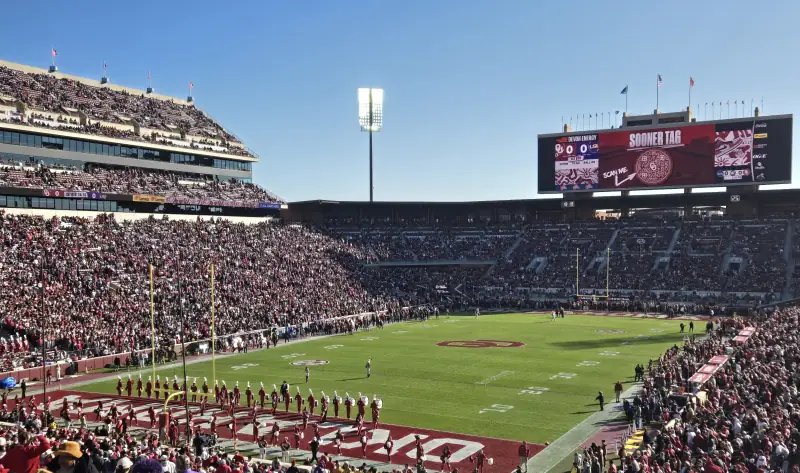
"Boomer Sooner"
Who wrote "Boomer Sooner," and when?
Arthur M. Alden, an OU student in history and physiology whose father was a Norman jeweler, wrote the words in 1905. He borrowed the tune from Yale's "Boola Boola." A year later a section from North Carolina's "I'm a Tar Heel Born" was added, and the two were combined into the song OU sings today.
When is it played?
After touchdowns. A 1940 Sooner Magazine story noted that "every O. U. touchdown is a cue" for the band to play it, and it has stayed that way. The Pride also plays it at the end of every rehearsal, and on game day the band marches onto the field playing it. In the 1983 Bedlam game, the band played "Boomer Sooner" nearly 300 times as OU came back to win.
Has the song changed?
Yes. A 1989 Sooner Magazine story quoted OU music professor James Faulconer saying the song "has changed in both rhythm and lyric": early versions ended with "Oh, by gum!" instead of "OK U," and he believed today's version took shape in the 1930s and 1940s.
What are the words?
As OU publishes them today:
Boomer Sooner, Boomer Sooner Boomer Sooner, Boomer Sooner Boomer Sooner, Boomer Sooner Boomer Sooner, OK U!
Oklahoma, Oklahoma Oklahoma, Oklahoma Oklahoma, Oklahoma Oklahoma, OK U!
I'm a Sooner born and Sooner bred and when I die, I'll be Sooner dead Rah Oklahoma, Rah Oklahoma Rah Oklahoma, OK U!
Words: Arthur M. Alden (1905), as published by OU; tune: Yale's "Boola Boola." The U.S. Copyright Office says "Boomer Sooner" "is now in the public domain." Band arrangements and recordings can still be under copyright, so we link to recordings instead of hosting them.
Sources: OU: History & Traditions (opens in a new tab); U.S. Copyright Office, Copyright Lore, May 2019 (PDF) (opens in a new tab); Sooner Magazine, Sept. 1940: "Sports Traditions" (PDF) (opens in a new tab); Sooner Magazine, April 1989: "Sooner Song Book" (opens in a new tab); OU Bands: the Pride of Oklahoma (opens in a new tab); Sooner Magazine, July 2004: "100 Years of the Pride of Oklahoma" (opens in a new tab). Last verified Nov 13, 2026.
The OU Chant
What is the OU Chant?
OU's alma mater. It was written in 1936 by Jessie Lone Clarkson Gilkey, who directed the OU girls' glee club from 1936 to 1938 and was named Outstanding Faculty Woman in 1937. Gilkey later said she copyrighted the song and gave it to OU, so we don't reprint the words here. OU publishes them on its History & Traditions page (opens in a new tab).
Why do fans raise one finger?
When the Chant is played, fans are encouraged to stand and raise one finger in the air. OU describes it as a sign of the university's greatness and of unity among all Sooners. The 1989 Sooner Magazine story describes the crowd singing the Chant before each home football game, with the words shown on the scoreboard.
Sources: OU: History & Traditions (opens in a new tab); OU Athletics: Sooner traditions (opens in a new tab); Sooner Magazine, April 1989: "Sooner Song Book" (opens in a new tab). Last verified Nov 13, 2026.
"Oklahoma!" and "O.K. Oklahoma"
Is "Oklahoma!" the state song?
Yes. State law names "Oklahoma," by Richard Rodgers and Oscar Hammerstein, as the official state song. It was adopted in 1953 and replaced an earlier, unofficial song, "Oklahoma, A Toast," by Harriet P. Camden. The song comes from the 1943 Broadway musical Oklahoma!, Rodgers and Hammerstein's first collaboration. It is still under copyright, so we don't print the words.
What is "O.K. Oklahoma"?
A Fred Waring song that premiered in a live broadcast on Dec. 1, 1939. At OU football games, it plays as the team kicks the extra point after a touchdown and the Sooner Schooner rolls onto the field. The arrangement used today was written by John Higgins in the early 1970s, at the request of new band director Gene Thrailkill.
Sources: Oklahoma Statutes, 25 O.S. § 94.1 (OSCN) (opens in a new tab); Oklahoma Historical Society: State Emblems (opens in a new tab); OU: History & Traditions (opens in a new tab). Last verified Nov 13, 2026.
The Sooner Schooner and the RUF/NEKS
What is the Sooner Schooner?
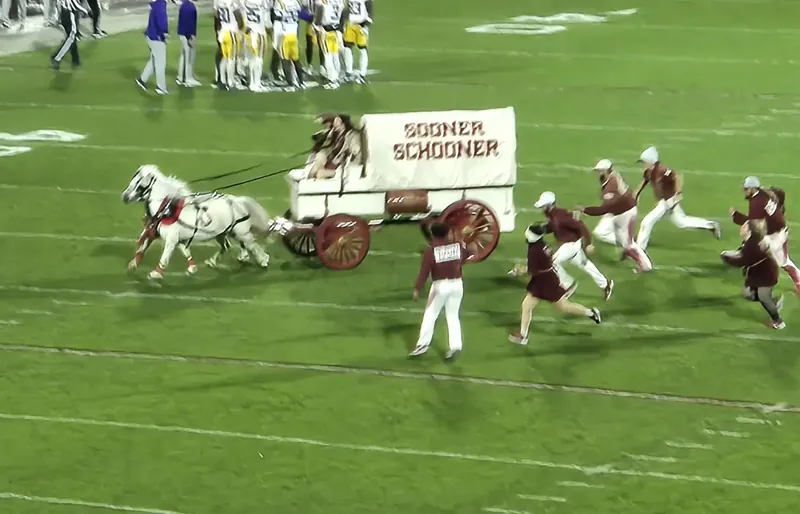
A scaled-down Conestoga, or covered wagon, like those of the pioneers who settled Oklahoma Territory around the 1889 Land Run. Two matching white ponies named Boomer and Sooner pull it across Owen Field in a victory ride after every OU score. It was introduced in the fall of 1964 and became the official mascot of the Oklahoma Sooners in 1980.
Who drives it?
The RUF/NEKS and the RUF/NEK Lil' Sis spirit squads maintain and drive the Schooner. Mick Cottom, a freshman RUF/NEK, was the first to drive it across Owen Field in 1964. Darby Dean, a senior Lil' Sis member, became the first woman to drive it during a game, in 2020.
Who are the RUF/NEKS?
OU's spirit squad founded in 1915. The RUF/NEK Lil' Sis program followed in 1973. Together they're responsible for the Sooner Schooner and the ceremonial shotguns fired on the sideline.
More on the Schooner's 1964 debut, its ponies, the RUF/NEKS' history, cheer, pom and OU's mascots: the Sooner Schooner, the RUF/NEKS and OU's spirit squads.
Sources: OU Athletics: Sooner traditions (opens in a new tab); OU Athletics: RUF/NEKS and RUF/NEK Lil' Sis (opens in a new tab). Last verified Nov 13, 2026.
The Pride of Oklahoma
When was the band founded?
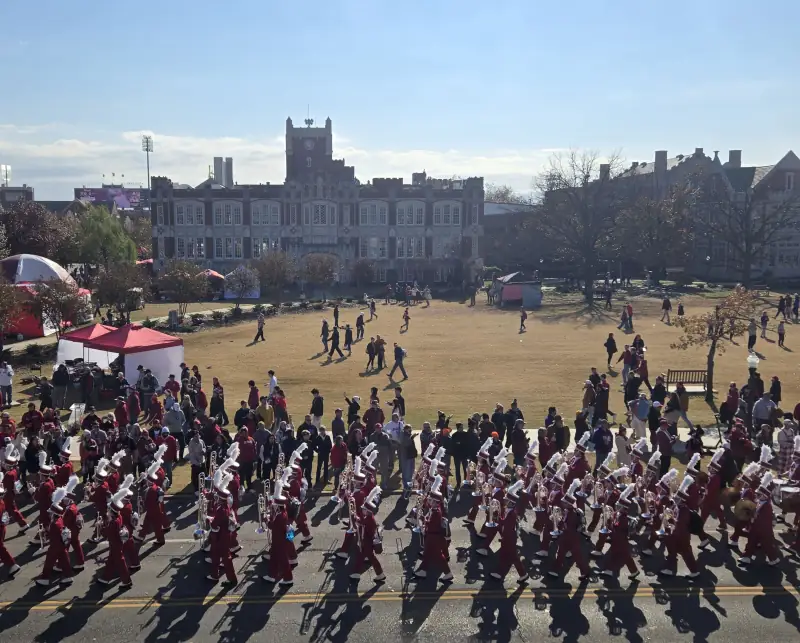
OU dates the Pride of Oklahoma to 1904, three years before statehood. Professor John Merrill started a band in 1901, but it was made up mostly of townspeople and broke up after each football season. Lloyd Curtis founded the first continuing student band in 1904. Unlike many college bands that began as military drill units, the Pride started as a pep band.
How big is it?
For the 2026 season, the Pride marches with 328 student musicians. About three-quarters of them major in something other than music, across more than 70 majors.
What awards has it won?
The Pride won the Sudler Trophy in 1987, under director Gene "Coach" Thrailkill. The award is often called the "Heisman of collegiate marching bands."
Who has directed it?
- Leonard Haug directed the band from 1945 to 1962. Sooner Magazine's band history says he planned formations with toy soldiers on a miniature football field.
- Gene Braught took over in 1962.
- Gene "Coach" Thrailkill led the Pride from 1971 to 2001. Under him the band won the Sudler Trophy, and in 1983 he introduced its popular Halloween halftime show.
- Brian Britt became director in 2001 and again when he returned to OU in 2014. As of 2026, he directs the Pride.
Where has the Pride performed?
Under Britt, the band has marched in the Macy's Thanksgiving Day Parade and twice in the Tournament of Roses Parade, and it has played at 21 bowl games. Earlier highlights include a nationally televised 1963 Orange Bowl show.
Sources: OU Bands: the Pride of Oklahoma (opens in a new tab); OU: History & Traditions (opens in a new tab); John Philip Sousa Foundation: Sudler Trophy winners (opens in a new tab); OU News, Aug. 2024: the Pride at 120 (opens in a new tab); Sooner Magazine, July 2004: "100 Years of the Pride of Oklahoma" (opens in a new tab); Sooner Magazine, 2022: Gene Thrailkill, 1938-2021 (PDF) (opens in a new tab); OU School of Music: Brian Britt (opens in a new tab). Last verified Nov 13, 2026.
Listen: official recordings
These videos are from the Pride of Oklahoma's own YouTube channel, which OU links from the band's page. Nothing loads from YouTube until you press play. Visit the Pride of Oklahoma channel (opens in a new tab) for more.
-
Pride of Oklahoma pregame (opens in a new tab)
The band's pregame show at Owen Field.
-
First Boomer! 2026 (opens in a new tab)
The 2026 band plays its first "Boomer Sooner" of the season.
-
Gene "Coach" Thrailkill: a celebration of 120 years (opens in a new tab)
A tribute to the band director of 1971-2001.
-
1939 Orange Bowl halftime (opens in a new tab)
Archival film of the Pride at the 1939 Orange Bowl.
Videos checked Nov 13, 2026. Pressing play loads YouTube's privacy-enhanced player (youtube-nocookie.com), and Google's privacy policy applies.
Traditions FAQ
Who wrote "Boomer Sooner"?
OU student Arthur M. Alden wrote the words in 1905, to the tune of Yale's "Boola Boola." A section from North Carolina's "I'm a Tar Heel Born" was added a year later, per OU.
Is "Boomer Sooner" in the public domain?
Yes. The U.S. Copyright Office (Copyright Lore, May 2019) says "Boomer Sooner" is now in the public domain. Specific band arrangements and recordings can still be under copyright.
Who wrote the OU Chant?
Jessie Lone Clarkson Gilkey wrote the OU Chant, OU's alma mater, in 1936. Fans stand and raise one finger while it is played.
When did the Sooner Schooner start?
OU Athletics says the Schooner was introduced in the fall of 1964 and became the official mascot in 1980. Ponies named Boomer and Sooner pull it.
When was the Pride of Oklahoma founded?
OU dates the band to 1904, when Lloyd Curtis founded the first continuing student band. The Pride won the Sudler Trophy in 1987.
OklahomaSoonerFootball.com is an unofficial fan site and isn't affiliated with OU, OU Athletics, the Pride of Oklahoma or the RUF/NEKS. Sources last verified Nov 13, 2026.